The Beekeeping Year
January
There really isn't much to do this month, apart from checking up on the hives to make sure that everything is okay and the entrance is clear of snow and the bees have enough stores. If you haven't done an Oxalic Acid treatment then you need to do it soon before the queen starts laying and while the hive is broodless. With warmed winters many colonies now rear brood all through the winter. In this case the treatment may not be as effective.
Get into the habit of hefting’ your hives. This will allow you to estimate the level of stores in the hive. Hefting is the method of ‘lifting’ the hive, to judge the weight of the hive + bees + stores available.
- Make sure you keep an eye on how much food your bees have. Brood rearing will start in earnest soon and if food is not available the bees will starve
- Make sure you have emergency food available, just in case
Planning for the season ahead
- Enrol yourself on a beekeeping course; this would be a beginner's course for your first year or one of the BBKA exams/assessments for those who already have bees
- Decide what you want to do in the apiary this year; do you want to do any queen rearing? Move hives? Requeen any colonies?
- Decide how you intend to deal with the control of mites, swarming and colony increase
Check your equipment
- Clean up (if not already done) and paint hives
- Sterilise frames with acetic acid (80%)
- Check stock and buy any new equipment you need
- Sort out your workbox
- Use drawing pins to identify which brood frames you have replaced
February
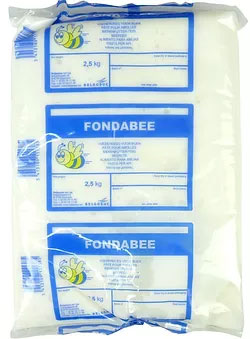
Brood rearing will continuet this month and will place an extra burden on the colonies' winter reserves. Check quickly for remaining honey reserves by hefting or looking quickly under crown board/through perspex cover if weather is not too cold or windy. If necessary be prepared to feed candy/fondant. Some beekeepers put fondant on anyway as insurance.
With brood-rearing commencing again, the mite load within the colony will start to increase so this is a good time if you haven’t done so already, to check your mite drop. Heavy infestations will require a spring treatment of the colony, e.g. Amitraz which works at low temperatures. Though it would have been better to treat with Oxalic Acid in late December/early January with minimal brood before mite build up occurred.
- You may see references to a varroa calculator on BeeBase. This has been removed. Instead there is a leaflet "Managing Varroa" which has comprehensive guidance to managing Varroa and includes a chart using proportion of infected drone brood to decide on appropriate methods of control.
In some areas the first of the spring bulbs are flowering so as the new seasons' pollen loads return on workers, allow them unrestricted access; remove mouse guards if fitted to the hive entrance.
Whilst things are still reasonably quiet, make the most of the time to put together new frames and hives and do any cleaning/organising you didn't get around to in January.
March
By this time most of us will have some idea as to how many of our bees have come through the winter. This is the time of the year when we lose most bees. Just because you see bees flying from the entrance does not mean all is well! The bees could be robbing out a dead hive.Your bees have not survived the winter until you see a hive with a good number of bees and brood.
Colonies should be showing signs of early spring activity. Queens should be laying patches of eggs in the warmth of the cluster and workers will be increasingly going on cleansing flights. On the milder days, workers may also be seen bringing in pollen from early flowering plants like snowdrops, crocuses and winter heaths.
Monitor the mite drop by checking the Varroa trays. Check will also show amount of brood emerging and stores being uncapped.
If you have a perspex crown board you will be able to see the bees and probably stores. A material quilt can be gently peeled back for a quick look.
Regular checks of apiaries should be carried out to ensure that any surrounding fencing is stock-proof, no vandalism has taken place and there is no damage to the hives.
Each hive should be hefted to check on the amount of food stores remaining.

Check for the following signs at the hive entrance
- If large pieces of wax are on the alighting board, you may have a mouse in residence!
- Spots of faeces may be evident on the front of the brood chamber. This can be caused by the bees’ long confinement due to severe weather, therefore preventing cleansing (toilet) flights. It may also be dysentery caused by fermenting stores or Nosema disease. Nosema needs to be treated, so if you see signs of dysentery, have your bees checked.
If the weather is mild enough and bees are flying freely, bringing in large pollen loads and you can detect warmth when placing the back of your hand against the crown board, then all should be well.
If there are fewer bees flying from one hive compared to others in the apiary or no flying bees at all, a quick check can be made by raising the crown board and having a peek inside.
Bees that are short of food must be fed syrup using a contact feeder.
Rapid, Miller or Ashforth feeders are unsuitable for early feeding because the bees will not go up over the cold ‘weir’ to reach the syrup.
April
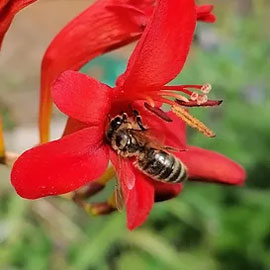
This month bees will be collecting nectar and pollen from flowering currant, dandelion, willow, cherry, gorse and blackthorn, leading to rapid colony build-up.
Continue to monitor the food supply and the mite drop on the hive inserts.
On the alighting board, or outside the hive, hard grey old pollen pellets the size of a cell may be seen. If crushed between the fingers they will break up and show layers. Sometimes a trace of colour might still be visible. The appearance of old pollen pellets is a good indication that the bees are expanding their brood nest.
Chalk Brood mummies may also be observed at the hive entrance. These do not crumble into layers, they are usually smaller and flatter than pollen pellets and are often recognizable as poorly developed pupae. Chalkbrood can appear if bees have wintered in damp conditions, especially when the winter has been mild and wet, and can be seen in nuclei that are short of bees. In other words, where the bees have been under stress. Some strains of bees are more prone to it than others. If widespread, chalkbrood can hinder colony buildup. Apiguard ( a Varroa treatment) encourages hygienic conditions within the hive and may reduce the occurrence of chalkbrood. In severe cases, the colony should be requeened from a different strain and any badly affected combs replaced with acetic acid sterilised combs.
If you need to treat for varroa in spring, it should be carried out before the hives have honey supers added. Do not use Apiguard or any other thymol-based treatment prior to the honey flow as its odour can remain in honey for some time.
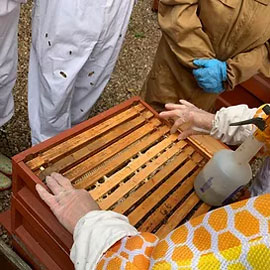
Towards the end of April or when the sun is warm and there is little wind, a first inspection can be made. The hive entrance should be gently smoked, then wait a few minutes before opening the hive in order to allow time for the smoke to take effect. Gently lever up the crown board and give it a sharp shake above the open hive to dislodge the queen back into the brood chamber IF she has been driven onto the crown board by the smoke. This inspection should be swift so that you do not chill the brood. The first thing to do at this first inspection is to find the queen. She is more easily spotted at this time because there are fewer bees in the colony and as there are no, or few, drones, she is the largest bee. She is likely to be found on a frame containing eggs in the top brood chamber. She might not be the queen which you are expecting to find; The queen that you saw during your last autumn inspection may have been marked and/or clipped, but a younger unmarked queen may now be in the hive, the old one having been superseded in late autumn. If you can do your inspectioin without using smoke you have a better chance of finding the queen.
April is the best time of the year to mark the queen. Use a ‘press-on’ type queen cage to mark her, aka "crown of thorns". When marking, ensure that you allow the paint to reach the hard surface of the queen’s thorax. If you only paint the thorax hairs, the paint will very soon wear off. Once marked carefully lift the cage a small amount but keep the queen in the cage until the paint has dried. The one shown here with metal pins is much better than the plastic one.
Tips for the first inspection
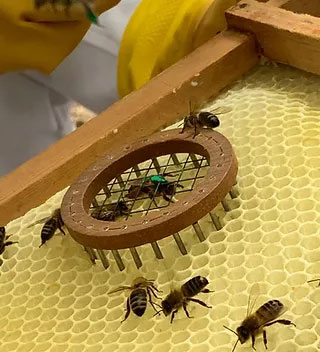
- When looking for a queen, concentrate solely on that task. When found, and marked, you can leave her in the cage until you have carried out other tasks so that you know her whereabouts. Don’t forget to release the queen before closing the hive
- The remainder of the brood chamber/s can now be checked quickly. It is important that you refresh your memory on the appearance of healthy, sealed and unsealed brood so that any abnormality can be given a closer examination
- Check that there are nice areas of eggs and larvae also slabs of sealed brood with few ‘missed’ cells. Continue to check for signs of disease
- Check that the colony has enough food to last it until your next visit
- Now is the chance to remove misshapen combs or combs clogged with old hard pollen and replace them withdrawn combs, if you have them! If not, only replace one or at the most two with foundation. The renewal of three or four brood combs per year helps to cut down disease
- Do not split the brood nest or you will give the colony a severe setback. Let the brood expand naturally.
- Carefully close up the hive and put some insulation e.g. an old carpet over the crown board. You need to keep the brood as warm as possible at this time of year.
- And Finally, fill in your hive records
Continue to monitor varroa numbers by checking the hive inserts and/or uncapping drone brood with an uncapping fork. Be careful not to kill too much drone brood or you may seriously reduce the drone gene pool which will be available for queen mating later in the season.
Swarming will be upon us by next month so you should now work out what you are going to do when you see your first queen cells. It is no good to wait until you first find them. You must have a plan to act upon when you do!
May – welcome to the swarming season!
"A swarm of bees in May
Is worth a load of hay;
A swarm of bees in June
Is worth a silver spoon;
A swarm of bees in July
Is not worth a fly"
May brings the start of the spring honey flow from sources such as oilseed rape, sycamore, horse chestnut, bluebell, top fruit, etc. and in order to derive maximum benefit from these, the colonies must be strong. Indeed, the beekeeper’s skill is in keeping colonies as strong as possible from May until August.
We have no way of predicting what the weather is going to be like or how long good foraging conditions will last, therefore you must endeavour to maintain your colonies as strong as possible so that they can make the most of any flow. This means that you must deter or delay swarm preparations at least until the spring flow is over and exercise effective control over swarming if or when it comes.
Never open a hive unless you have a reason for doing so and have a plan worked out in advance for what you are going to do and have what equipment you may require at hand.
In early May the colonies should be checked in order to see that the queen has not suffered any ill effects. There is no need to find the queen, just check for the presence of patches of eggs.
There should now be drones in the hive. Bees work best when they have some drones, but you don’t want too many. Drones do not become fertile until they are twelve to thirteen days old.
Check that the queen has plenty of space in which to lay. A queen excluder and the first honey super are put on top. This super should be of drawn comb if you have it so that when the flow starts, honey will be stored in the super and not allowed to clog up space in the brood chamber.
After a week of the honey flow more breeding and super room should be provided as the season progresses.
Make sure that there is enough super room for storage of honey and for the bees to ‘hang nectar out to ripen’ in spare cells.
Tips for swarm management and queen cells
- Colonies are checked weekly to ensure there is enough super room and that swarming preparations are not being made
- If queen cell cups, with nothing in them, are found, this is quite normal and need not be removed
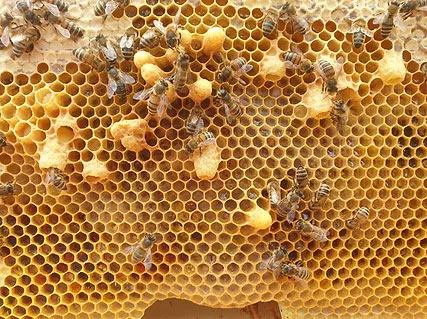
- If queen cups are being extended and contain an egg, or more importantly, a fed larva, then you must assume that swarming will take place soon after the queen cells are sealed on the ninth day after the egg was laid
- Be careful cutting out queen cells, make sure there are eggs present (i.e. you have a laying queen) or you could render the stock queenless
- If cells are removed they will probably be rebuilt the following week and you must remedy the situation using your chosen method of swarm control
- The queen cells which were found first of all will contain larvae properly fed from birth therefore they will produce the best queens and should be used if you intend to breed from that stock
- An artificial swarm is probably the best way to proceed if you are a beginner
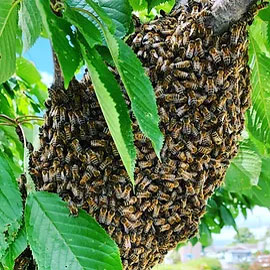
If you are lucky enough to catch a swarm hive it on foundation and leave for a few days before feeding it well.
A swarm is one of the best ways of obtaining a good drawn out comb from your bees!
June - 'The June Gap'
So called because there can be a 'gap' in the nectar produced by the plants. Spring flowering shrubs and trees have finished flowering and the flowering plants which produce the main nectar flow of the year, in most areas, have not started flowering.
However; this gap is variable. In some years it may be absent, in others prolonged. All depends on the weather. Careful attention is required. It may be necessary to feed the bees at this time. If the spring has been good, the bees stored a superful of honey and the beekeeper has removed this for his own use there may well not be enough stored in the brood chamber for the bees. Remember that at this time of year there will be a lot of brood. Feed with 1:1 Sugar syrup.
July - The main honey producing time.
Hopefully you will have thwarted your colony's attempts to swarm and you have a strong colony, lots of bees to collect the abundant nectar.
Make sure you have enough supers on the colony and hope for good weather.
August - Harvest time
When the supers are full and the cells capped off then they can be removed and the honey extracted. Check the water content of the honey. It should be less than 20%. 18 - 19% is even better. Once the supers have been extracted they can be put back on the hive, over the crown board, the bees will clean up the remaining drops of honey leaving the supers 'dry' for winter storage.
Varroa treatment.
Once all the supers have been removed then the hives can be treated for Varroa. It is important to do this as soon as possible. The queen will be starting to lay the eggs which will develope into winter bees, her rate of laying stats to decrease in July but the Varroa numbers continue to rise. So:- more Varroa per bee larva. Treat before there are too many. The winter bees must be healthy so they can live through the winter months.
September - Varroa treatment and winter feeding
A colony needs about 20kg of stores for the winter. In rough terms this means a super full of stores as well as stores in brood box. If you do not want a large honey crop you could leave them a super of their own honey. But if you want to remove and extract the supers then the bees will need to be fed.
Strong sugar syrup 2:1. IKg sugar to 630mls water (2:1 relates to imperial measures. 2lb sugar to 1 pint water). Or purchased feed ( eg Ambrosia or Invertbee syrup)- slightly more concentrated. Continue to feed till bees have enough. Stop before weather turns colder. The bees need to reduce the water content to < 20% to store safely.this takes time. Some people move the super underneath the brood box for the winter. Remove the queen excluder.
October - preparing for the colder weather
Make sure the hives are sound and watertight. Opinions differ on insulation. Poly hives are better insulated than National hives. Neither is as well insulated as the bees' natural home in a tree trunk. Insulation above the crown board certainly helps. Perspex crown boards allow you to see the bees after removing roof and insulation without letting much cold air into the hive. Open mesh floors can allow significant ventilation. Place a well fitting screen in the floor. This will stop most of the draught and you can pull out floor from time to time and check for any Varroa as tell from the debris on the screen how many seams of brood there are and where stores are being uncapped.
November - late autumn
In recent years we have had mild weather in November and the bees have been flying. Start to heft the hive to check for the amount of stores. Energy (stores) will have been used but there is unlikely to be any nectar for the bees to collect. If there is any doubt put some fondant on now.
December - Getting ready for winter
As the year draws to a close the bees should be clustering quietly in the hive with plenty of stores to see them through the rest of the winter. The queen will have reduced her laying and, especially if she is a dark queen, and the weather is cold she may cease laying altogether. After the winter solstice on 21st December, the queen’s laying will slowly increase with the lengthening days.
This is the time to treat for Varroa again as, ideally, there is no brood and all the Varroa mites are on the adult bees and susceptible to treatment. Oxalic Acid is the substance to use and is now available as an authorised treatment as Api-Bioxal which comes as a sachet containing powder. It can be applied either as a trickle in sugar syrup or by vaporisation/sublimation.
Read the instructions carefully and follow them precisely.
To trickle, 500ml of 50% syrup is used for one packet. It is stated that this will treat ten hives as 5ml is trickled per seam of bees. However, as few hives contain ten seams of bees at this time of year it will usually treat significantly more hives. Take care not to exceed 5ml per full seam.
Vaporisation requires a special device to heat the powder. Be very careful not to inhale any of the fumes.
Oxalic Acid can be used at any time of year when there is no brood, but should only be used once per hive per year.
Check the weight of the hives and place fondant on any that are light.